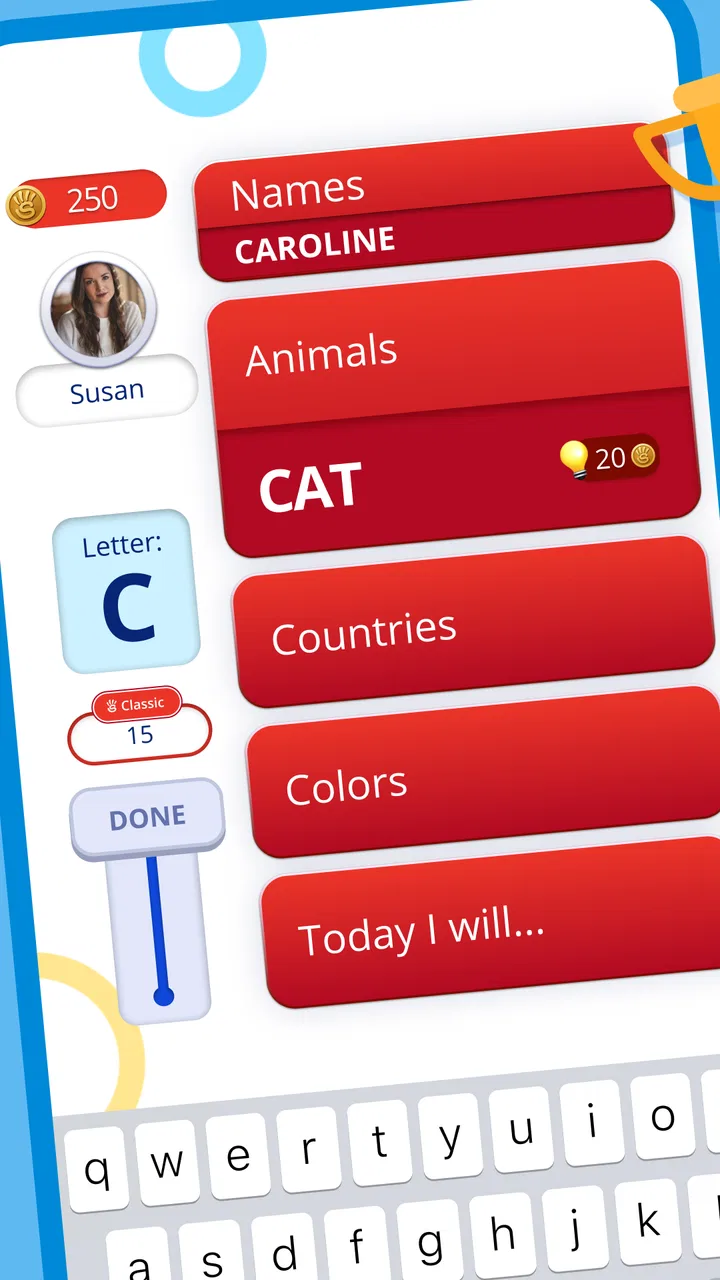
Stop 2 - Word Trivia Game
- 4.4
- Rating
- 10.00M
- Installs
- Free
- Price

 Analysis by App-foxy
I enjoy word games most when they make me think quickly without turning a short break into a serious study session. Stop 2 - Word Trivia Game takes that approach through category-based riddles and fast quiz rounds. It is a free word game from Fanatee, Inc., aimed at playing with friends and keeping the pace lively rather than building a long, complicated campaign.
After spending time with it, I see the main decision as simple: do you want a compact social word challenge, or are you looking for a deep solo puzzle with careful, unhurried solving? Stop 2 is much stronger in the first situation. Its appeal comes from the pressure of producing an answer while a category is in front of you, then seeing how your thinking compares with everyone else’s.
The game is available for Everyone and has attracted a broad audience, with an average rating of 4.3 from around 106 thousand ratings and more than 10 million installs. Those figures suggest that its quick, approachable format has found a substantial audience, but they do not remove the need to consider how you personally like to play word games.
You May Also Like

 Pandora - Music & Podcasts
Pandora’s Music Is Easy to Start, but Harder to Recover
Pandora’s strength is its low-effort path from a seed to a station. Its weak spot is how much confidence it asks you to place in connection, setup, and quiet recovery.

 8 Ball Pool
 Is Built on Rivalries, Rematches, and Routine
A close look at the rivalries, rematches, shared routines, and unanswered safety questions that turn a quick pool match into a persistent mobile community.

 Samsung Music
’s Quiet Strength Is Playing What You Already Own
Its reach comes less from spectacle than from dependable access to a personal library. That simplicity is both the app’s strongest retention engine and its ceiling.

 AccuWeather: Weather Radar
AccuWeather Review: A Quick, Clear Forecast for Everyday Decisions
For everyday plans, the best forecast is the one you can understand quickly. AccuWeather makes rain timing, radar, and local conditions easy to act on, with a few trade-offs.

 Hill Climb Racing
Why Hill Climb Racing Still Turns Crashes Into One More Run
A tiny car, a bumpy hill and one more upgrade: Hill Climb Racing keeps resurfacing because its simple chaos makes every near-miss feel personal.

 AliExpress - Shopping App
AliExpress Makes Global Shopping Feel Personal, but Shoppers Bear the Risk
AliExpress turns a global marketplace into a pocket-sized discovery engine. Its reach is useful, its shopping loop compelling, and its trade-offs easy to miss.
More From Our News Desk
View All News


How I decide whether this word game fits
My first test for a game like this is the time commitment. Stop 2 works best when I have only a few minutes and want an activity that begins immediately. I do not need to prepare a board, learn a large rule set, or remember a complicated progression system before I can enjoy a round. That makes it a natural choice for a lunch break, a commute, or a relaxed evening with a friend.
The second test is whether the central challenge stays understandable under pressure. Here, the focus is on solving category riddles in a fast-paced quiz format. That combination matters: the category gives me a direction, while the clock-like feeling encourages the first plausible answer instead of endless overthinking. I find that more engaging than simply searching for words in a static grid.
The third test is social usefulness. This is not the kind of word game I would choose only for quiet vocabulary practice. Its strongest moments come when another person is involved and a familiar category suddenly produces completely different answers. A friend may interpret the clue literally, while I take a cultural or everyday angle. That difference creates the conversation after the answer, which is a large part of the fun.
There is also a useful distinction between knowledge and reaction speed. You can know plenty of words and still hesitate when several answers seem possible. Conversely, someone with a smaller vocabulary may do well by recognizing the intended direction quickly. I like that balance because it stops the game from feeling like a simple test of who has memorized the most unusual terms.
What the category format changes
Category riddles give each turn a loose frame, but they leave enough room for interpretation to make the result unpredictable. That is more interesting than a word puzzle where every move is determined by a fixed board. I have to decide whether to choose the obvious answer, search for something less expected, or trust the first word that appears in my mind.
A practical tip is to avoid treating every clue as if it has one perfect answer immediately. In a quick round, I first identify the broad subject, then narrow it using the wording and the likely level of the game. This keeps me from wasting the entire turn chasing an overly clever response. The best strategy is often not the most obscure word; it is the answer I can produce confidently before the pace breaks.
Another useful habit is to notice which categories make me hesitate. Those are not necessarily weaknesses in vocabulary. Sometimes the problem is that I am trying to generate an answer alphabetically or logically when the game rewards association. Switching from “What is the technically correct word?” to “What would most people say first?” can make the experience smoother.
That small change also explains why the game is suitable for mixed groups. A player who is not comfortable with traditional crosswords can still participate because the prompts invite ordinary knowledge and quick connections. At the same time, experienced word-game players may enjoy the challenge of staying accurate while moving quickly.
Where Stop 2 is at its best
The clearest strength is accessibility. The rules are easy to grasp, and the category-riddle concept gives new players an immediate way into the action. I would feel comfortable suggesting it to a friend who says they are not normally a word-game person, especially if we were going to play together rather than leave them alone with a difficult puzzle.
It is also well suited to repeated short sessions. I can play when I have a small amount of free time without feeling that stopping halfway through would ruin a carefully planned solve. That makes it different from a long-form puzzle app, where the pleasure often comes from maintaining concentration over a single demanding problem.
The social format creates another advantage: the game can become a prompt for discussion. After a category appears, players naturally explain why they chose a particular word or laugh at an answer that technically fits but feels unexpected. In my experience, that makes it more valuable at home or during casual gatherings than a solitary word search would be.
There is a subtle benefit for families and mixed-age groups as well. Because the content rating is Everyone, it is positioned as a broadly accessible game rather than something designed for a narrow adult audience. That does not mean every round will be equally easy for every person, but it does make the game easier to bring into a shared setting where players have different interests.
For someone who wants a low-friction way to exercise recall, I would use it as a warm-up rather than a formal learning tool. A few rounds can encourage faster association and remind me of words I already know, but I would not confuse that with a structured vocabulary course. The game’s purpose is entertainment first, and it succeeds more through momentum than through lessons.
Small techniques that improve the experience
When I play with friends, I find it helpful to agree on the spirit of the answers before starting. Are we rewarding the most common response, accepting any reasonable fit, or enjoying the most creative interpretation? Clarifying that early prevents debates from becoming frustrating. It also lets the group choose whether it wants a competitive quiz or a more relaxed conversation game.
I also recommend treating hesitation as information. If I repeatedly freeze on a certain kind of category, I do not immediately blame the game. I ask whether I am reading the clue too narrowly, relying too much on visual memory, or trying to produce a unique answer when a simple one would work. This turns each round into a small exercise in flexible thinking.
A third approach is to play in short bursts instead of forcing a long session. The fast format is energizing at first, but any reaction-based quiz can become tiring when every turn demands immediate attention. Stopping while the game still feels lively makes it easier to return later, and it preserves the friendly tone that makes the social mode appealing.
Finally, I would keep the game separate from situations where accuracy has real consequences. It is a playful word challenge, not a reference source. If a category leads to an argument about a fact, I would treat that as a reason to check a reliable source afterward, not as proof that the game should settle the question.
When another type of word game may be better
Stop 2 is not the right choice for every word-game player. If I want a quiet, methodical experience, I would lean toward a crossword, a traditional word search, or another puzzle where I can pause and inspect every possibility. Those formats reward patience and precision in a way that a fast category quiz cannot always provide.
It may also disappoint players who want a substantial solo progression system. The attraction here is the round-to-round challenge and the social comparison, not a large narrative journey or a carefully structured course. If your ideal game gives you a long-term personal objective, detailed customization, or a campaign that unfolds over time, you may prefer a different category of app.
Players who dislike subjective answers should think carefully before choosing it. Category riddles can invite more than one reasonable response, and the enjoyment depends partly on accepting that language is flexible. Someone who wants every puzzle to have one indisputable solution may feel more comfortable with anagram games, spelling challenges, or grid puzzles with fixed answers.
There is also a difference between playing against friends and playing alone. The game’s social promise is most convincing when other people are available to respond, compare answers, or react to surprising interpretations. If you usually play offline and privately, a dedicated solo word puzzle may offer a more consistent experience, even if it has less spontaneous humor.
I would not choose it as my main tool for serious language improvement either. It can encourage recall and broaden the kinds of associations I make, but it does not replace a dictionary, a language course, or deliberate practice with definitions and usage. Its value is in making word thinking feel quick and playful.
Everyday use: a realistic short session
Imagine meeting a friend after work with only a little time before heading home. A long board game would be inconvenient, while a detailed puzzle might require more concentration than either of you wants. Stop 2 fits that gap: open it, start a quick category challenge, and let the answers become the conversation.
In that situation, I would not focus solely on winning. I would pay attention to how each person approaches the category. One friend may answer rapidly with familiar words, while another may wait and offer something unusual. The contrast gives the session personality, and the game becomes more than a series of prompts on a screen.
The same pattern can work during a family break, provided everyone is comfortable with the pace. Younger players may contribute surprising answers, while older players may have broader general knowledge. Since the format is straightforward, nobody needs to spend the first part of the gathering learning elaborate rules.
On the other hand, if I were trying to relax before sleep, I might choose something slower. The quick-response pressure can be stimulating rather than calming. That is an important trade-off: the same speed that makes the game lively in a group can make it less suitable for a quiet wind-down routine.
Free access and the practical cost of switching
The game is free to start, which lowers the barrier for trying it with friends. That matters for a social title because convincing a whole group to pay before anyone knows whether the format works would be difficult. I can test the basic experience first and decide whether it deserves a regular place on my phone.
There are in-app purchases ranging from $0.99 to $99.99 per item. I would keep that range in mind before handing the device to a child or allowing casual purchases. The free entry is useful, but it is still worth reviewing purchase settings so the low-friction design does not turn into an unexpected expense.
Switching from another word game is easy in terms of learning the concept, but the real cost is changing what I expect from the genre. Someone coming from a crossword may need to accept faster decisions and less solitary focus. Someone coming from a competitive quiz may need to accept that word association and interpretation matter as much as stored facts.
The technical entry point is also reasonably broad. The current version is 1.6.2, and it runs on Android 7.0 or later. That makes it accessible to many older Android devices, although I would still consider the age and general performance of a particular phone before expecting a perfectly smooth experience from any modern app.
Because the game is free, the main switching cost is not money; it is attention. If I already have several daily puzzle habits, adding another quick quiz can become repetitive unless it fills a distinct role. For me, its role is social, spontaneous play. If that is not missing from your current collection, the reason to switch is weaker.
Who should choose it?
I recommend it to people who want a friendly, fast word challenge that can be shared with friends. It is especially appealing if you enjoy category prompts, quick associations, and the small arguments that happen when two answers seem equally sensible. It is also a good starting point for someone who finds traditional word puzzles intimidating.
I would be more cautious about recommending it to a player who wants deep solo content, a slow pace, or a strict answer structure. Those preferences are not flaws; they simply point toward a different kind of word game. Stop 2 is at its most convincing when the player welcomes speed and treats the social exchange as part of the reward.
My final recommendation is to try it as a lightweight group game rather than expecting it to replace every other word puzzle on your phone. Fanatee, Inc. has built an approachable quiz experience around category riddles, and the format delivers genuine fun when the right people are involved. If you want quick thinking, shared laughs, and minimal setup, this is an easy free game to test.
For my own use, I would keep it available for short breaks and casual gatherings, while choosing a crossword or a more deliberate puzzle when I want sustained concentration. That distinction is the key to enjoying it: Stop 2 is not trying to be a complete vocabulary course or a grand solo adventure. It is a brisk, social word game, and within that lane it is a worthwhile recommendation.
FAQs for Stop 2 - Word Trivia Game
01What is Stop 2 - Word Trivia Game?
Stop 2 - Word Trivia Game is an engaging and competitive word game where players must quickly think of words that fit specific categories. The challenge lies in coming up with unique answers to outsmart opponents and earn points. Available on both Android and iOS, it offers single and multiplayer modes.
02How do you play Stop 2?
To play Stop 2, you start by selecting a category and receiving a random letter. The goal is to think of words that fit the category and start with the given letter before the timer runs out. You can play against friends or random opponents, making it a fun social experience.
03Does Stop 2 require an internet connection?
Yes, Stop 2 requires an internet connection for multiplayer matches and syncing your progress. While you can enjoy some features offline, such as practice rounds, the full experience with leaderboards and competitive play against others is best enjoyed online.
04Are there in-app purchases in Stop 2?
Stop 2 offers in-app purchases, which include additional categories, themes, and power-ups to enhance gameplay. While the game is free to download and play, these purchases can provide a richer and more personalized gaming experience if you choose to invest.
05Is Stop 2 suitable for all age groups?
Stop 2 is suitable for a wide range of age groups, as it combines fun and learning. The game encourages vocabulary expansion and quick thinking, making it a great choice for both kids and adults. However, parental guidance is recommended for younger children to ensure appropriate content exposure.
Pros
- Engaging and challenging word puzzles.
- User-friendly interface with intuitive controls.
- Daily challenges keep players returning.
- Wide variety of categories and topics.
- Offline mode available for gameplay on the go.
Cons
- Limited hints can be frustrating for beginners.
- Ads can be intrusive during gameplay.
- Occasional bugs cause app to freeze.
- Some categories feel repetitive over time.
- Limited social features for competitive play.

Stop 2 - Word Trivia Game
Gallery